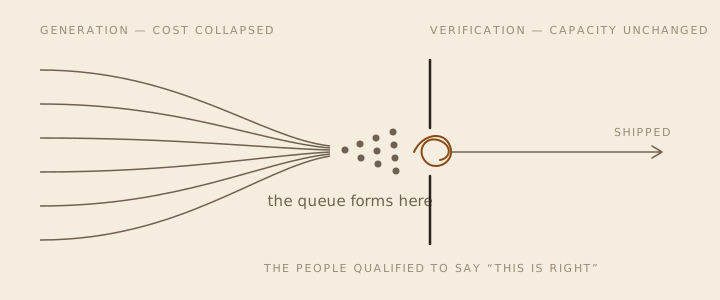
The point at which AI-assisted production grows faster than an organisation’s capacity to establish whether the resulting work is correct.
In one line
Generation gets cheaper. Verification doesn’t.
What you see
Adoption went fine. Drafts, code, analyses, and decks now appear in a fraction of the old time. And yet the organisation does not feel faster, because everything produced still has to pass through the small set of people qualified to say “this is right”, and those people now have five times the inbound. The bottleneck did not disappear. It moved up the seniority ladder and got worse.
The symptom usually arrives wearing a different name: “senior management overload”, or “quality concerns about AI”. The organisational response is to slow adoption down, which throws away the gain without fixing the constraint.
What is actually happening
Production and verification used to be roughly balanced: writing the report took long enough that checking it was a minor cost. AI broke that balance. Generation is now nearly free, while verification still costs what it always cost, and in some cases more, because plausible-looking AI output is harder to check than an honest first draft from a junior.
Organisations that rolled out AI without redesigning verification have simply moved their constraint to the most expensive people in the building.
Why AI changes the constraint
This is constraint migration in its most common form. AI accelerated one stage of the workflow, production, and left the surrounding system unchanged. The constraint did not vanish; it moved to the next step that stayed the same, which in most knowledge work is review.
What I see in practice
When AI increases output volume, the work concentrates on the smaller group qualified to verify it. Review queues grow, senior calendars saturate, and the people the organisation can least afford to lose become its rate limiter.
My interpretation
The constraint moves up the seniority ladder. Verification was never designed as a system; it was an implicit duty of seniority, and AI just multiplied the load on an undesigned process.
The evidence, and what I’ve observed
Published evidence
The UK Government’s response to the AI Champions’ adoption plans (June 2026) finds that scaling adoption is often less about the model than about whether workers can interpret and act on its outputs. MIT Sloan reaches the same join from the other side: real value from AI depends on being able to verify its outputs. And in software specifically, the developer-tooling world has documented faster code generation producing slower reviews.
One note on the name: “verification bottleneck” has prior lives, in chip design and more recently in code review. I use it for the organisational version: the whole firm’s capacity to establish that work is correct, not one team’s tooling problem.
Observed in practice
A real engagement, anonymised to sector and scale. Every client gets that deal.
Every report the team produced funnelled through two people. AI could ease that. It could also make it worse.
A small planning consultancy. Every report was reviewed by the director and MD, which made the top of the firm a quality bottleneck. The team had already reached for ChatGPT on their own, ad hoc, with no structure and no rules about what was safe to put into it.
So I started with the stack in front of them, not a shopping list.
They already had Microsoft 365 and Claude, so I worked with what they owned and picked two focused experiments where AI could actually earn its place: quality-checking a draft before it hit review, and assisting the first draft of a section. Then a phased rollout, so nothing landed faster than the team could absorb it.
I also ran a follow-up session on the questions that actually hold professional-services firms back: which provider to trust, how to keep client data safe, what order to do things in.
Ad hoc became structured. A small set of sanctioned uses, a safe way to try them, and clear answers on risk.
If that sounds like you: a team already using AI in the shadows isn’t a problem to stamp out. It’s the signal for where to make it structured and safe first.
How to diagnose it
The signals are cheap to check: review queues that grow faster than output, senior calendars filling with checking rather than deciding, and adoption being slowed “for quality reasons” while individual usage keeps climbing. If the people qualified to approve work are your most overloaded people, you are looking at this pattern.
When this isn’t the pattern. If the output failing review is genuinely poor, you have a generation problem, not a verification problem: fix the prompts, the context, or the model before touching the review process. If work clears review quickly but then waits on someone to say yes, the constraint has moved past verification into decision rights, which is a different pattern. And if verified work ships but the needle doesn’t move, the constraint is in deciding what to build at all: the product team ceiling.
What changes
Treat verification as a designed system rather than an implicit duty of seniority. That means tiering outputs by blast radius (most AI output does not need senior review; some needs more than it is getting), building verification into the generation step (structured outputs, self-checks, source citation as a requirement rather than a courtesy), and accepting that some checking is itself automatable. The goal is a verification cost that scales with the new volume, instead of a senior team that quietly becomes the org’s rate limiter.
You know it’s working when verification cost scales with the new volume instead of piling up on the most expensive people in the building. Senior review is reserved for high-blast-radius output; the rest is checked at the point of generation. The counterintuitive result: adoption speeds up, because trust is designed in rather than rationed out, and your senior people go back to the work only they can do.
Related patterns and reading
- Constraint migration — the mechanism underneath this pattern, and the map of where else the knot turns up
- AI pilots that never reach production — verification is one of the joins where pilots die
- The new bottleneck isn’t productivity. It’s verification.
- Prompting Is Dialogue, Not Instructions