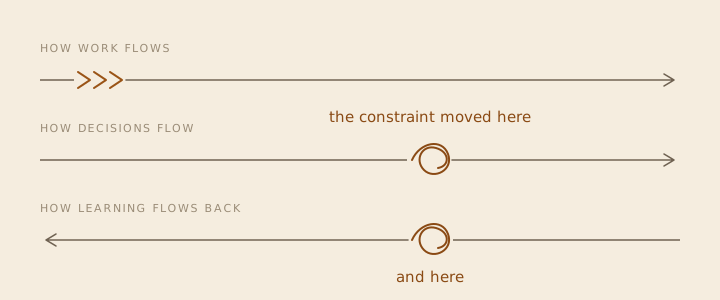
The point at which a product team’s outcomes are limited by its operating model rather than its talent: by how work, decisions and learning flow, not by how hard people push.
In one line
The ceiling is the operating model, not the talent.
What you see
The velocity charts are fine. The roadmap is full. Nobody is slacking, and there is no obvious villain. But the needle the team exists to move has not moved in quarters, and the unspoken response has been to add process: more discovery templates, more prioritisation frameworks, more alignment meetings. Each addition feels rigorous. Collectively they are sediment.
What is actually happening
Three flows determine what a product team can do: how work flows (queues, handoffs, batch sizes), how decisions flow (who can say yes, and how long that takes), and how learning flows (how fast a signal from a user changes what gets built).
When effort stops translating into outcomes, one of these three is silted up, and pushing harder increases the pressure without increasing the throughput. The cruel part is that the visible response, working harder and adding process, actively worsens the constraint, because every new artefact adds another queue.
Why AI changes the constraint
AI sharpens this pattern rather than softening it. It collapses the cost of building and experimenting, which is constraint migration aimed straight at the other two flows: the constraint shifts even harder onto deciding and learning. A team that could not prioritise at the old speed of building definitely cannot prioritise at the new one. Cheap building with expensive deciding just means the queue in front of “what should we build?” grows faster.
What I see in practice
Teams that adopt AI coding and prototyping tools without touching decision or learning flow report the same thing within a quarter: more built, more shipped, same outcomes. The backlog moves faster into production, and production moves no faster into learning.
How to diagnose it
Map the three flows against real recent work and find which one is binding. Pick the last three significant things the team shipped and time the journey honestly: how long building took, how long the decisions around it took, and how long before a user signal changed anything. The slowest of the three is your constraint, and it is rarely the building.
If you want to run that mapping without me in the room, Flowscope does it self-serve: an AI coach interviews the team, the map builds live, and it ranks where the flow actually waits. Free to start.
When this isn’t the pattern. If decisions are fast but they keep getting remade above the team, the constraint is decision rights at the organisational level: the transformation that ran out of road. If the team learns fast but everything waits on review and sign-off, the constraint is verification: the verification bottleneck.
What changes
Remove sediment rather than adding process: fewer queues, shorter decision paths, faster signal loops. The fix is usually subtractive, which is why teams rarely find it themselves; nobody gets promoted for deleting process. When the fix warrants outside hands, this is what the Operating Model Redesign Sprint does — subtractively, on real work, with a defined end.
You know it’s working when effort translates again. The team ships less process and more outcomes, decisions take hours instead of sprints, and a user signal changes the backlog the same week it arrives. The velocity charts look roughly the same — that was never the problem — but the needle the team exists to move starts moving, and stays moved.
Related patterns and reading
- Constraint migration — the mechanism: cheap building moves the constraint onto deciding and learning
- Why Your Product Team Is Stuck (And It’s Not Your Fault)
- Discover Phase Mastery for AI-Native Teams