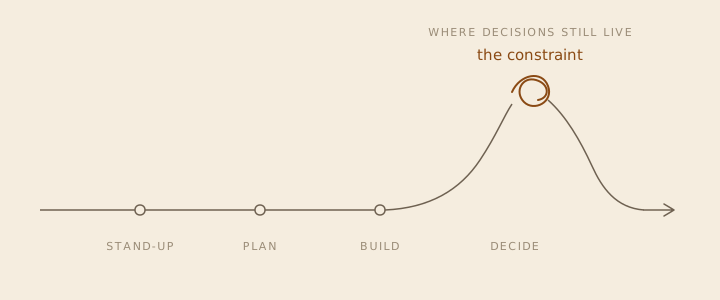
The point at which a transformation has adopted the visible ceremonies of a new way of working while leaving decision rights and feedback loops unchanged, so work moves at its old speed under new names.
In one line
If decision rights did not move, the transformation did not happen.
What you see
The stand-ups happen. The boards are full of cards. The quarterly planning event runs like clockwork. And yet the thing the transformation was supposed to buy you, faster decisions, faster learning, faster delivery, never arrived. Eighteen months in, the honest people in the room admit that work moves through the organisation at roughly the speed it did before, just with more meetings describing it.
By this point there is usually a second consultancy on site, recommending a refinement of what the first one installed.
What is actually happening
Ceremonies are the visible layer of a transformation, so they get adopted first and measured most. But the thing that determines speed is invisible: who can decide what, with whose information, and how long it takes a lesson learned at the edge to change behaviour at the centre.
Teams perform autonomy in the ceremony and queue for permission afterwards. The friction reads as a people problem, so the organisation responds with more training, which changes nothing, because the constraint was never knowledge.
The framework was not the problem. The operating model underneath it was, and the framework was laid on top like new carpet over a broken floor.
Why AI makes this sharper
This pattern predates AI, and AI is now the most common way of rediscovering it. AI adoption lands on the same unmoved operating model the transformation left behind: tasks accelerate inside teams while every decision still queues where it always queued. That is constraint migration with the constraint already sitting at decision authority, which is why organisations with a stalled transformation tend to plateau fastest on AI. The acceleration arrives; the permission structure it needs never did.
What I see in practice
The organisations getting real value from AI first are the ones whose earlier transformation genuinely moved decision rights. The ones that adopted ceremonies without moving authority hit the same wall twice, and the second time they paid AI prices for it.
How to diagnose it
Trace three or four recent pieces of work end to end and find where they actually waited. The wait points map the real constraint, and it is almost never where the org chart says it should be. A decision made in a ceremony that gets remade above it afterwards is the signature signal.
You can do that tracing yourselves: Flowscope is my self-serve mapping tool — an AI coach interviews your team, builds the value-stream map live, and the wait points fall out of the conversation. Free to start.
When this isn’t the pattern. If decisions are genuinely fast but the work between them crawls, the constraint is in flow, not authority: look at the product team ceiling. If decisions are fast and work flows but review chokes everything, the constraint has migrated to verification: the verification bottleneck.
What changes
Not another framework. Redesign the smallest set of decision rights and feedback loops that unblocks the flow, and prove it on real work before rolling anything out. That second half is a productised shape: the Operating Model Redesign Sprint — £30k fixed, four to six weeks, defined end.
You know the floor is fixed rather than re-carpeted when a decision made at the edge stays made, and a lesson learned by a team on Tuesday has changed what the centre does by Friday. The ceremonies get lighter, not heavier, because they’re carrying real decisions instead of performing them. Work moves at the speed the transformation originally promised, and nobody needs a consultancy on site to keep it that way.
Related patterns and reading
- Constraint migration — the mechanism: here the constraint sits at decision authority
- Why Your Product Team Is Stuck (And It’s Not Your Fault)
- Making Better Decisions Faster