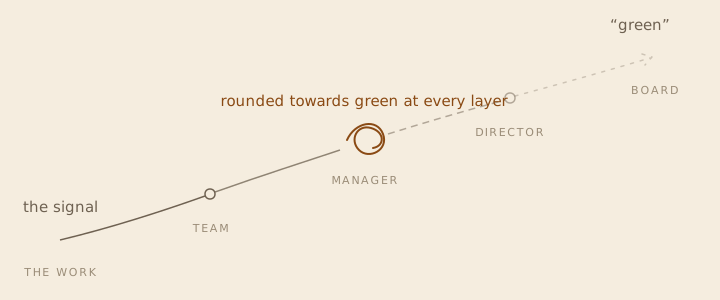
The state in which structural and commercial filters strip the signal from upward reporting, leaving an executive with full reporting and no information.
In one line
Full reporting, no information.
What you see
Every review meeting ends with reassurance. Every consultant engagement ends with a framework and a follow-on proposal. Meanwhile the numbers you actually care about drift sideways, and you have started to trust your own unease more than your own reporting. The question you cannot get answered is embarrassingly simple: what, specifically, is stuck?
What is actually happening
Two filters sit between you and the truth. The first is structural: information that travels upwards through an organisation gets summarised at each level by people whose performance is being judged on it. Nobody is lying, exactly. But every layer rounds towards green, and by the time it reaches you the signal is gone.
The second filter is commercial: most external advisors are incentivised to find the kind of problem their practice sells the solution to. A methodology firm will find a methodology gap. A technology firm will find a technology gap. What almost nobody sells is the short, bounded engagement that names the constraint and then stops, because naming the constraint quickly is bad for revenue.
Why AI makes this sharper
AI adoption multiplies the volume of activity that can be reported while leaving the two filters exactly where they were: constraint migration, with the constraint sitting in information flow. More pilots, more dashboards, more usage metrics, all rounding to green on the way up. An executive can now be shown more evidence of progress than ever while knowing less about whether anything changed. If you are funding an AI programme, the straight-answer problem is not a side issue; it is the reason you cannot tell which level the adoption actually reached.
How to diagnose it
The test is one question asked of your own reporting: can it tell you, in one sentence, what specifically is stuck? If the answer arrives as a status, a percentage, or a framework stage, the filters are on. The second signal is external: count how many advisor engagements in the last two years ended with a named constraint and no follow-on proposal attached. Zero is the pattern.
When this isn’t the pattern. If you can name the constraint but nothing happens to it, information flow is fine and decision authority is stuck: the transformation that ran out of road. If the honest answer is that nobody in the building knows, not even filtered, the gap is measurement, which is what a diagnosis is for.
What changes
Go around both filters, briefly and deliberately. A short diagnostic that talks to the people doing the work, traces real items end to end, and reports what it finds directly to you, in writing, with no follow-on engagement assumed. The deliverable is a named constraint you can test against your own judgement, not a transformation programme. What you do with it, and with whom, stays your call — and if what you want afterwards is simply the truth on call while you act, that exists too: Advisor on Call, the only day rate I carry.
Observed in practice
A real engagement, anonymised to sector and scale. Every client gets that deal.
The CEO wanted AI to fix it. The honest answer was that AI wasn’t the problem, and it wasn’t the fix either.
A South West software company, scaling its product team. The CEO was losing about an hour a day to a manual, broken purchase-order process, reconciling by hand. He’d already decided AI was the answer and wanted help buying it.
So I told him the thing he didn’t want to hear first.
This was a process problem wearing an AI costume. Automating a broken workflow just gets you broken faster. So we fixed the workflow: right-sized the batches, and put the right tool on data capture at the point it entered the system.
Only then did I show him where AI genuinely earns its place, once the process is sound. Turning unstructured data into structured. Spotting patterns across a very large record base. Natural-language search over records nobody had the time to read.
He stopped shopping for AI and fixed the thing actually costing him an hour a day. The AI roadmap came after, aimed at the work only AI can do, not the work a better process solves for free.
If that sounds like you: before you reach for AI to fix something slow and manual, check it isn’t a process problem first. Automating a broken process just makes the mess arrive faster.
When it’s working
You can answer “what, specifically, is stuck?” in one sentence, and defend it upwards. Reporting starts carrying signal again — partly because the constraint is being fixed, and partly because every layer now knows the summary occasionally gets tested against reality. You trust your own dashboard slightly more than your own unease. That’s the right way round.
Related patterns and reading
- Constraint migration — the mechanism: here the constraint sits in information flow
- I Asked My Own Tool Whether It Should Exist — what taking honest diagnosis seriously looks like, applied to my own work
- Postcards from the AI Rollout You Are Already Inside Of